


Most beer rivalries happen at the bar over friendly debates and cold pints.
But the battle between America’s Budweiser and the Czech Republic’s Budweiser Budvar has been going on for generations, and it involves lawyers, trademarks, history, and a whole lot of beer pride.
This is not just a disagreement over a name. It is a clash between old world brewing tradition and modern global branding. And honestly, it might be one of the most interesting stories in beer history.
The Original Budweiser?
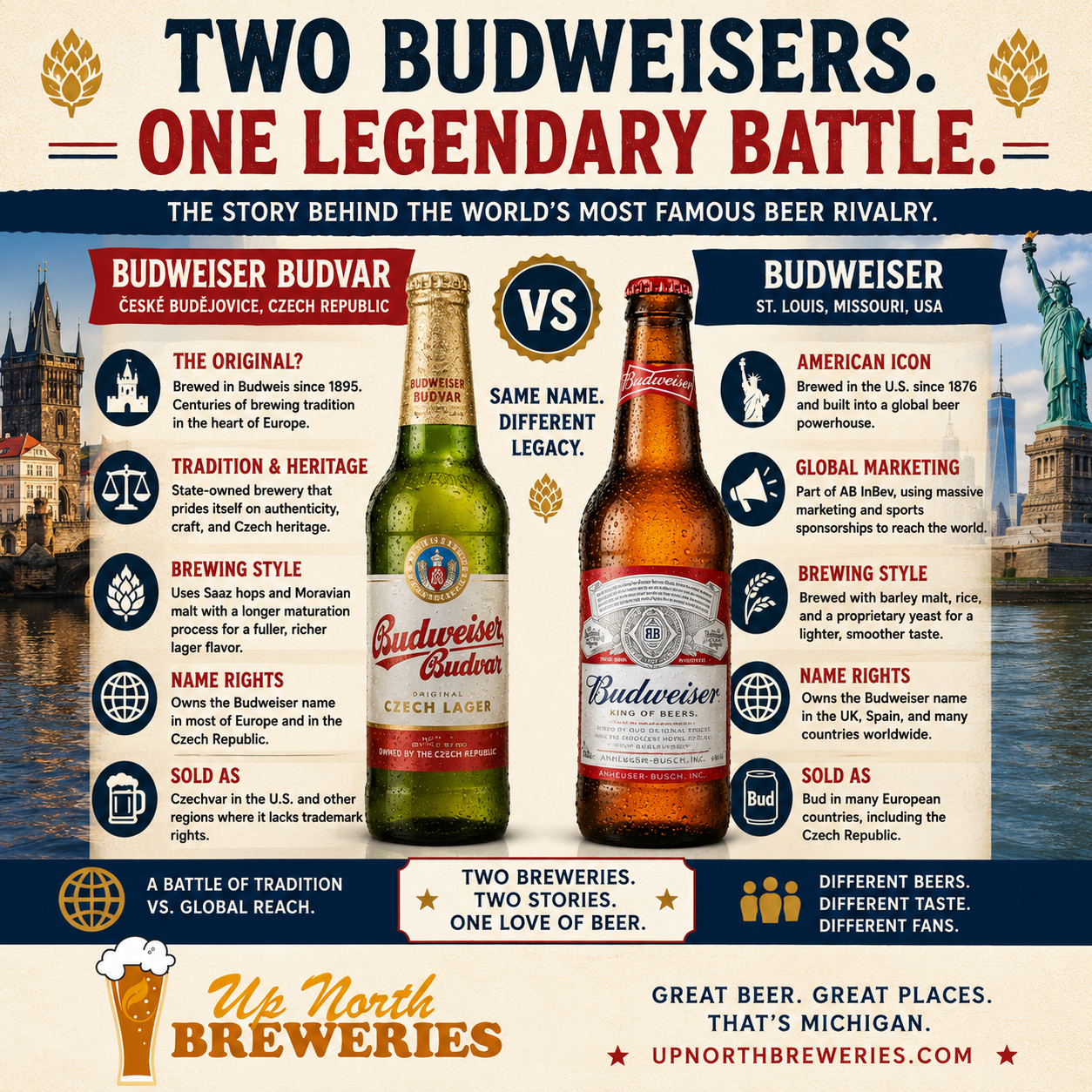
Budweiser Budvar Brewery was founded in 1895 in the Czech town of České Budějovice, known historically by its German name, Budweis.
Beer has been brewed in the region for centuries, and the name “Budweiser” originally referred to beer produced in Budweis. That historical connection is a major reason the Czech brewery believes it has rightful claim to the Budweiser name.
Meanwhile, Anheuser-Busch introduced its own Budweiser in the United States in 1876. Over time, the American brewery built one of the most recognizable beer brands in the world.
And that is where the fight began.
 The Trademark Battle That Never Seems to End
The dispute over the Budweiser name has stretched across decades and multiple countries.
Budweiser Budvar argues its claim comes from geography and centuries of brewing tradition tied to the city of Budweis. Anheuser Busch built its case through worldwide branding, marketing, and international distribution.
Depending on where you are in the world, one brewery may legally own the Budweiser name while the other cannot use it.
In many European countries, Budweiser Budvar controls the rights to the Budweiser name. Because of this, the American version is often sold simply as Bud.
Meanwhile, in places where Anheuser Busch holds the trademark rights, the Czech beer may appear under a different name.
Confused yet? Welcome to international beer law.
Why the Beer Names Change Around the World
One of the more interesting parts of this rivalry is how both brands adapted.
In the United States and several other markets, Budweiser Budvar is sold as Czechvar because it cannot use the Budweiser name there.
In much of Europe, the American Budweiser is sold simply as Bud due to trademark restrictions.
So depending on where you travel, ordering a “Budweiser” could get you two very different beers.
That definitely adds some excitement to international pub visits.
The UK and Spain Are Exceptions
While Budweiser Budvar holds naming rights in much of Europe, there are exceptions.
In the United Kingdom and Spain, Anheuser Busch won the legal rights to market its beer under the full Budweiser name. In those countries, the American version keeps its familiar branding.
Beer law gets surprisingly complicated once you cross enough borders.
Two Budweisers in the Czech Republic
In the Czech Republic itself, Budweiser Budvar fully controls the Budweiser name.
The American version is still available there, but it must be sold under the name Bud instead of Budweiser.
On its home turf, the Czech brewery remains the dominant Budweiser.
A Difference in Brewing Style
For many beer fans, the rivalry is not only about trademarks. It is also about taste and brewing philosophy.
Budweiser Budvar is often viewed as the more traditional European lager. It uses local ingredients including Saaz hops and Moravian malt, and the beer undergoes a longer maturation process.
The result is generally considered a fuller flavored and more traditional lager experience.
American Budweiser takes a different approach. Brewed with barley malt, rice, and a proprietary yeast strain, it delivers a lighter, smoother, and less bitter flavor profile designed for mass appeal.
Neither beer is necessarily “better.” They simply appeal to different drinkers.
Tradition vs Global Branding
At its core, this rivalry represents two very different approaches to brewing.
Budweiser Budvar emphasizes heritage, authenticity, and old world brewing traditions. The brewery is state owned and takes pride in its Czech roots.
Anheuser Busch focuses on scale, worldwide recognition, and massive marketing campaigns. Its Budweiser became a symbol of American beer culture through sports sponsorships, television ads, and global distribution.
One brewery represents centuries of European brewing history. The other represents the rise of modern global beer branding.
Two Brands That Found a Way to Coexist
Despite decades of legal battles, both breweries continue to coexist in international markets through different branding strategies.
Budweiser Budvar continues selling Czechvar in the United States, while American Budweiser often goes by Bud in parts of Europe.
It may not be the perfect solution, but it keeps both beers flowing worldwide.
And honestly, that is probably the most important part.
Beyond the Trademark
The battle between Budweiser Budvar and Anheuser Busch goes far beyond a simple trademark dispute. It tells the story of tradition versus expansion, local heritage versus global branding, and two breweries fighting to protect their identity.
Both beers carved out loyal followings around the world, and both remain important pieces of beer history.
So the next time someone orders a Budweiser, you might want to ask one important question first.
“Which one?”
 Marisa Fancy along with her husband and four children dreamt of moving “Up North”. They had vacationed for years in northern Michigan and in 1995 they finally made the move.